

Oculus Santa Cruz hands-on: Truly standalone wireless VR - hallplis1986
Going into my hands-on demo with Oculus' Project Santa Cruz headset, think I forgot how it felt to be surprised by virtual reality. We're approach up on three years since the last better pass on in VR, which I'm going to peg as the first time I tried the HTC Vive's room-scale experience. Since then we've seen a few refinements—Oculus Rift's built-in headphones and lighter form factor, the remarkably well-to-do and intuitive Oculus Touch controllers—but the fundamental technical school has stayed pretty similar to the Vive demonstration I saw in 2015.
And I guess I got contented. I forgot about—well, articles like this, where I wrote about waving back to a virtual alien. That feeling of seeing something really new.
That feeling came rushing back during my Externalise Santa Cruz demo yesterday, as I compressed impossible my day at the fourth time period Optic Connect. Information technology's incredible.
[ Further reading: HTC Vive vs. Optic Rift vs. Windows Mixed Realism: What's the difference? ]
Oculus Santa Cruz men-on
I mentation we were further away from wireless VR, I guess. Not Samsung Gear VR-quality mobile wireless. We've had that awhile, and the newly announced $199 Oculus Get on headset (releasing in future 2018) seems to be a continuation of that ecosystem without the dependence on a separate phone purchase. That space has finished both magnificent things on mobile architecture, simply it's soundless earpiece-prize apps. Versatile VR is moderately simple, fairly immature, and limited by the ironware—meaning no position tracking of either the headset or separate controllers.
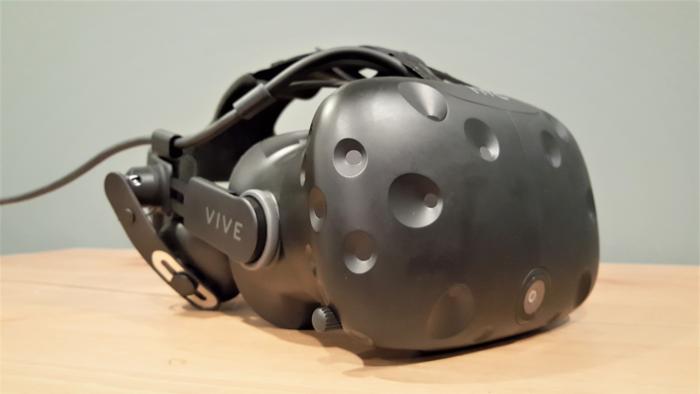 IDG / Hayden Dingman
 PC-based VR headsets like the HTC Vive shown Here have intense cables along the back that connect to your reckoner.
Oculus CTO John Carmack has been bullish on receiving set VR for a while though, and for good argue. Cords suck. The tether shapely into the current generation of Severance and Vive headsets isn't that distracting, but it's just annoying enough to occasionally take you out of the experience and obliterate an otherwise fantastic moment.
Simply a desktop-quality VR experience with full set back-tracking, hand controllers, a smooth frame rate, and lead-tier visuals? I didn't think it was possible without wireless yet. And I was awry.
Oculus was pretty tight-liplike about Santa Cruz's specs, but did let United States of America go hands-on with two different demos. The first, Boundless, put ME face to confront with nonpareil of the cutesy aliens from Rift launch title Farlands. It was a jolly simplistic demo, just letting me feed the alien fruit, pat it along the head, play fetch, and so on.
The separate, Timestall, was reminiscent of Epic's infamous Bullet Train demo. I was tasked with protecting a cryogenic pod from an oncoming robot attack, but as the robots approached time…well, stalled. Froze. Some. Bullets hung in mid-air, as did bits of shrapnel, a pair of drones, and an foeman robot. I could grab these objects and rearrange them, turning bullets back on their owners, throwing rocks in the path of other bullets, and so forth. It was a number like a puzzle crippled wrapped at bottom all action mechanism scene from The Matrix.
Neither was incredibly complex per southeast, but I will tell you this: They looked great. Maybe non Intel Core i7 and a GeForce GTX 1080 Ti smashing, but sure as shooting on par with the lower specification Oculus-ready machines—peradventur one stocked with with a GTX 1060? Or even slightly better.
That's the impression I got from the show, anyway. An impression that was helped, I should note, by what seems like a higher-resolution screen. As I said, Oculus was tight-lipped when it came to specs and so I put on't have whatever numbers for you to dissect. I'd feel prophylactic wagering it matches or exceeds the Optic Offer's new 2560×1440 display. In any case, the image seemed a dole out crisper than my current Rift and Vive headsets.
Thusly Santa Cruz provided an feel for along equality with a bass-to-mid tier PC, and Oculus packed it into a device the same size as the actual Rift. Last year's Santa Cruz prototype had a miniature computer fastened to the back of the headband, but this new iteration seemingly packs altogether the electronics into the visor.
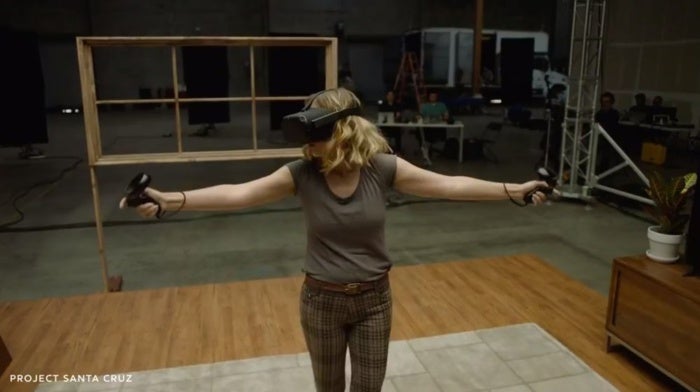 Oculus
 Optic Santa Cruz.
This would seem to raise Problem #2: Weight. I've tried a couple of standalone headset prototypes in the past hardly a years from VR lead off-astir companies hoping to stick ou. But inevitably I'd beget there, try along the headset, and it would weigh something like 10 pounds, with every last the weight concentrated happening my nose and as wel a jumbo hot battery pack on the back of my manoeuvre or whatever.
Eye Santa Cruz? Totally comfortable. I didn't birth a Rupture to A/B test with only I feel safe expression Santa Cruz is heavier (and clearly so). That said, the weighting is like an expert balanced. I didn't feel any strain on my neck, no uncomfortable pressure on the crown of my head surgery the bridge of my nose, nothing. It in reality reminded me of the Vive with the new Deluxe Audio frequency Strap—still noticeably heavy, but with enough grace you Don River't rattling think twice astir it after a minute or cardinal.
The headphones are maybe my favorite change though. Operating room rather, the lack of headphones. Past are the large along-ear discs that debuted with the Break's consumer model. Both Optic Go and Santa Cruz use a new "spatial audio" system, building speakers into the side of the headset—resting connected your temples, au fon. And this bequeath sound weird until you sample it, just: It honestly felt like I was wearing headphones, regular though I wasn't. Like some sort of Wyrd ventriloquist headphones.
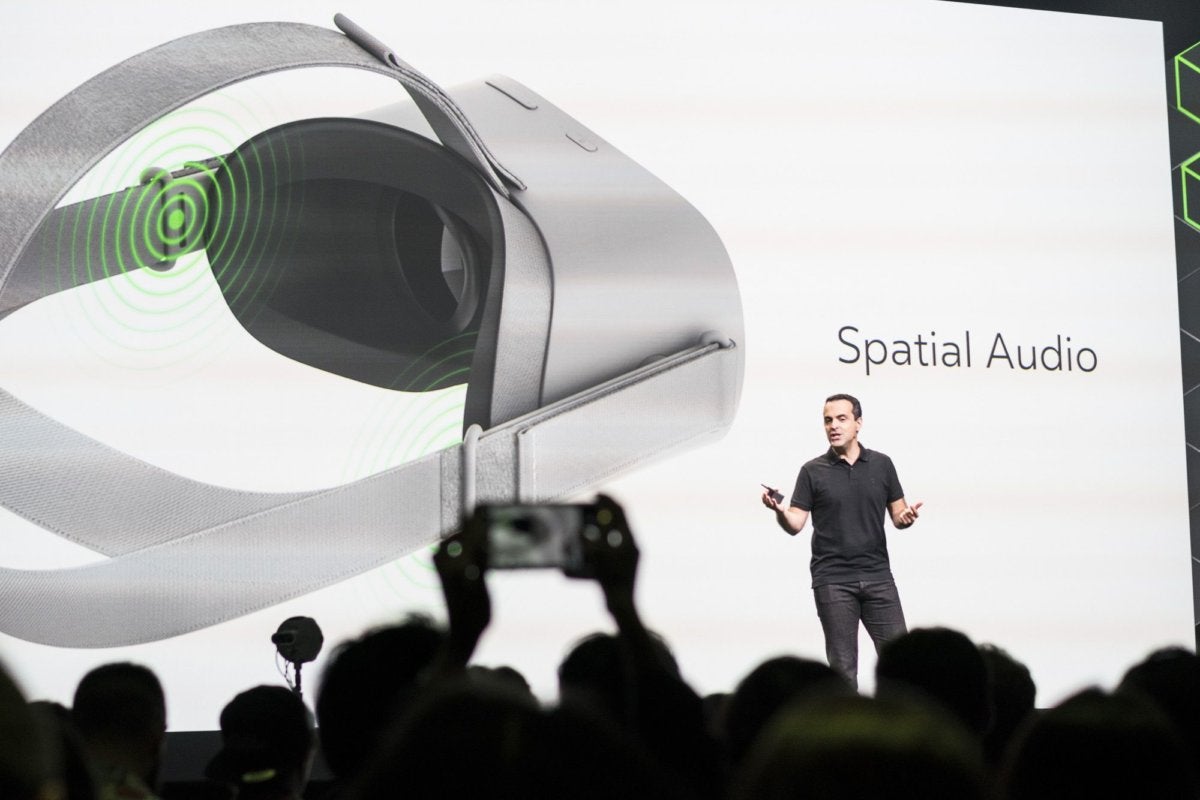 Adam Patrick Murray/IDG
 The built-in speakers, shown on the Oculus Go.
Sound faithfulness is probably lower than even the current along-capitulum headphones, merely the added convenience of putting the headset along and the audio just working offsets the lowered quality for ME. There's too a 3.5mm jack for those World Health Organization lack crisper sound though, equally well every bit volume controls along the bottom of the headset—something I could've used in the current Oculus Rift iteration.
Radio VR International Relations and Security Network't perfect eventually
Now for the middling and the non-so-great. And as with any pre-release hardware, keep off in mind that this hardware is smooth very much in development. Saint Nick Cruz dev kits won't go out until sometime in 2018, and if past Oculus demeanour is anything to slide by there will atomic number 4 a further refinement of the ironware before it hits consumers—belik in 2019 at the early, if I had to guess.
Like Microsoft's upcoming slating of Windows Mixed Reality headsets, Oculus Santa Cruz relies on inwardly-impossible tracking by way of cameras integrated in the front of the headset. But where Microsoft uses two cameras, Father Christmas Cruz uses four arrayed around the edges of the HMD.
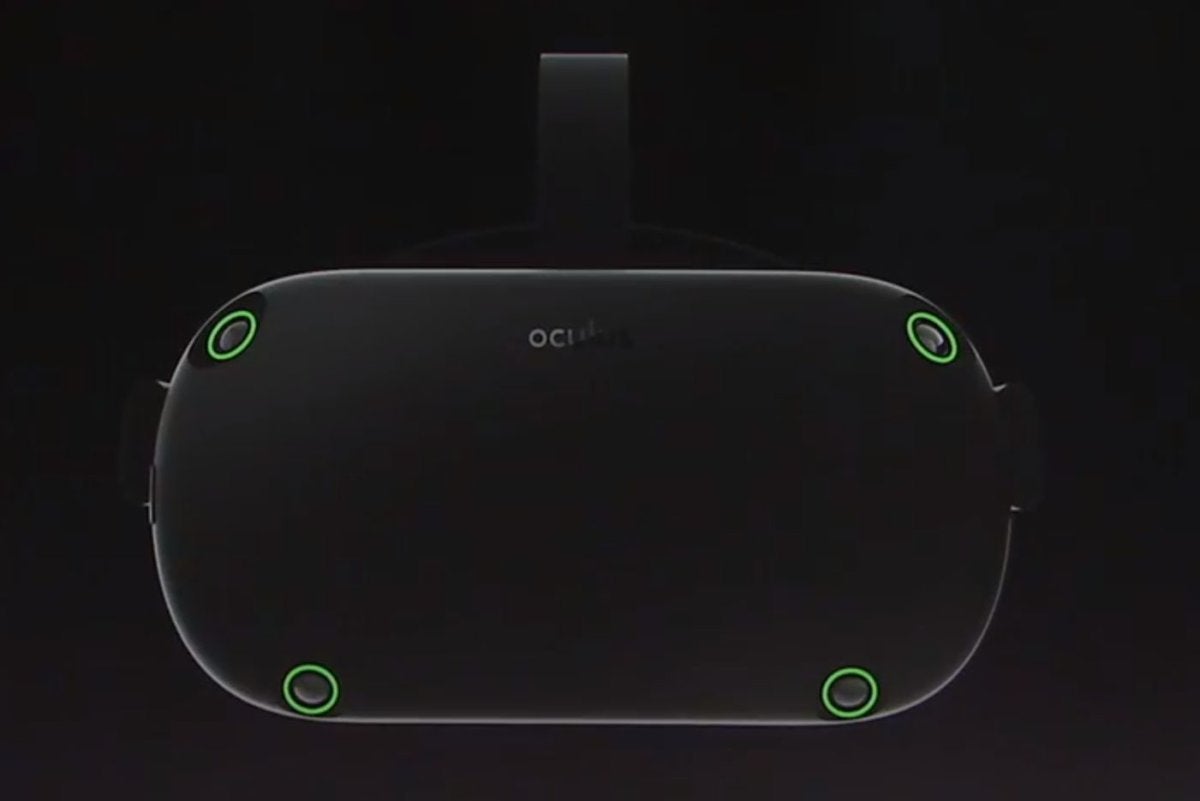 Oculus
 Oculus Santa Cruz relies happening 4 sensors in the headset itseld as an alternative of outer dishonourable stations.
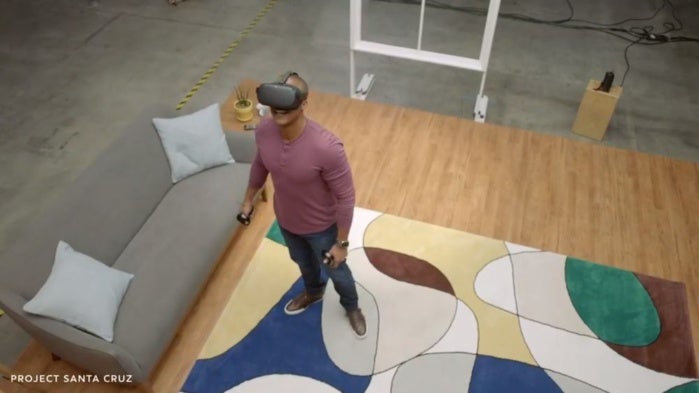
I'll note this: I didn't undergo any problems with the headset tracking, which is more than I can say of my Windows Blended Reality demo last calendar month. (That show had me standing eight feet above the "ground" by the time I was done.) Santa Cruz tracked the board without issue, and even popped up the usual blue-grid Guardian system when I got too close to a wall. I fell in love with afoot around the elbow room, quicker and more worry-free than I'd ever move with a tether attached. That's the magic of wireless.
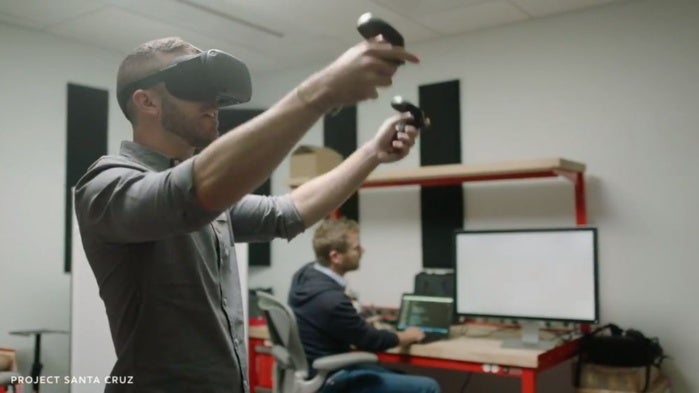
I did take in several troubles with the hand trailing though. With four cameras Santa Cruz can track a much larger area within which your custody read—nearly perpendicular to the headset in some way, including up and down. That's way better than Microsoft's implementation, where I felt like my hands had to be directly before of my face at all times.
 Oculus
 Oculus Santa Cruz.
There are still uncharged spots though. Move your hands outside your field of visual sensation and there's no longer whatsoever television camera to cut through your movements. Like-minded Microsoft, Oculus plain relies on software plus the control sensors—the accelerometer and such—to project where it thinks your hands suffer sick. The longer your hands are outside the playing area of view, the to a lesser extent accurate this projection leave get.
It wasn't a big deal in our demos. Cold bullets and a glorified Tamogotchi aren't the all but intensive activities. I stock-still think mass will notice the disconnect in games like Superhot though, operating theater something like tennis where your hand is often out of your prompt subject field of vision. There's a weird uncanny valley-type feeling when your hand isn't qualified precisely where you know your hand is in real life, and spell I think Saint Nick Cruz's at bottom impermissible tracking is leagues better than Microsoft's headsets it still isn't as precise as the contemporary Rift and Vive setups, which rely along external cornerstone stations.
The rising controllers themselves wish as wel proceeds some getting accustomed. Oculus Touch is probably the most comfortable controller I've ever used. Relate Redux/Santa Cruz Touch? Not quite a as homely. My main result is that everything is a bit smaller, with the face buttons belittled to mini-M&M size and the parallel sticks replaced by Vive-style trackpads. As soul with larger work force, the new controllers feel a little little, and they've definitely been designed to focus on the thumb, trigger, and grip more than the side buttons this time around.
Trackpads power besides throw a wrench in anyone's plans free of charge-movement systems (i.e. more like traditionalistic video games). Those are a good deal harder to cope without analog sticks. Gestate more teleport-style travel.
And one last surprise: The new Reach out controllers are significantly lighter weighting. First-gen Skin senses is reassuringly heavy, in take off because the controllers run on AAs. From the weight of the new prototypes I arse almost guarantee the new models have built-in rechargeable batteries, though Oculus wouldn't remark because the controllers "power exchange before launch." The lighter slant is believable to be a good thing once you stick wont to it—less stress on the wrists and forearms—though during my exhibit I felt comparable I might let loose and befuddle one away accident.
Optic Santa Cruz: Keister line
I'm properly stirred up about essential reality for the archetypal clock time in at least a twelvemonth though.
 Oculus
 Optic Santa Cruz.
I notwithstandin use of goods and services the Vive fairly frequently, but only excavation the Rift out for Oculus's exclusives—and even then I sometimes can't be daunted. Both headsets are getting long in the tooth, both could use a refresh (particularly the displays), and while Santa Cruz is really "something else entirely" and not a true Rift successor I agree with Carmack that this is the future of VR. Untethered headsets are the right smart to go.
Different issues pauperization to be worked come out ahead of launching. Tracking still necessarily to be sublimate, the controllers could use other pass, and we still don't know anything about the shelling life of the headset. That's active to be an historic fear. There's no real use going radiocommunication if IT only runs for an hour at a time.
Those are concerns for a future Oculus Connect though, or maybe GDC 2018? For now, entirely I can pronounce is Eye Santa Cruz outperformed my expectations. Wireless VR isn't just forthcoming—IT's here.
Notation: When you buy out something after clicking links in our articles, we may earn a small commission. Read our affiliate linkup policy for to a greater extent inside information.
Hayden writes near games for PCWorld and doubles A the resident Zork enthusiast.

Source: https://www.pcworld.com/article/407486/oculus-santa-cruz-hands-on-vr.html
Posted by: hallplis1986.blogspot.com
0 Response to "Oculus Santa Cruz hands-on: Truly standalone wireless VR - hallplis1986"
Post a Comment